

Quarry productivity is won or lost at the tool interface, where iron meets rock. The right attachment, paired and operated correctly, can raise throughput, lower cost per ton, and extend machine life. This playbook gives you a practical, numbers-driven guide to choosing, sizing, operating, and maintaining attachments that move the ROI needle.
Attachments 101
An attachment is a tool mounted to a carrier (usually an excavator or wheel loader). Examples include a hydraulic breaker (hammer), a rock bucket, a screening bucket, a hydraulic quick coupler, and even an onboard loader scale. The “right” attachment speeds up cycles, reduces rework, and cuts wear. Success shows up as more tons/hour, lower $/ton, fewer jams, cleaner product, and safer work zones.
Start with the bottleneck (don’t buy blind)
Before choosing any tool, identify what actually slows production. Time a handful of real cycles with a phone stopwatch and watch where minutes disappear. If the primary crusher chokes on oversize, the bottleneck is at the face or the grizzly. If trucks need too many passes or leave under/overweight, the problem is in loading and measurement. If screens blind or feed is inconsistent, pre-sorting is weak. Buy for the bottleneck that exists, not the one a brochure suggests.
The core attachments (what they do and how they help)
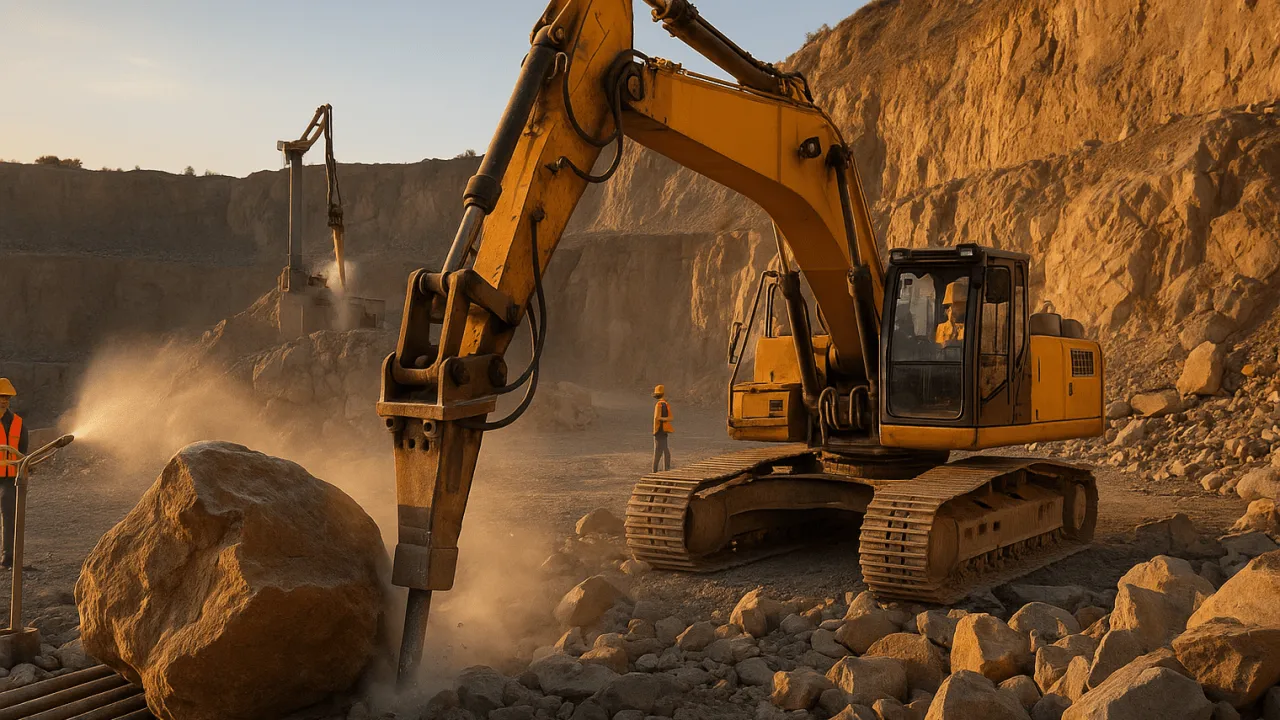
Hydraulic breaker (hammer). Breaks boulders and trims the face so the primary keeps flowing. Best practice is perpendicular contact, short controlled bursts, starting at edges or natural cracks, and never prying. Verify hydraulic flow/pressure and case drain requirements on the carrier before delivery.
Rock bucket for the wheel loader. Speeds loading with tougher wear steel and teeth that hold a high fill factor. Size capacity so typical trucks load in 3–5 passes—a sweet spot for cycle time and tire life. Dull teeth quietly drain productivity; swap or flip before they round off.
Screening bucket. Pre-sorts material, recovers fines, reduces blinding, and turns what looked like waste into saleable product. Works best with steady feed, correct screen aperture, and hydraulic flow that meets spec (not starved, not excessive).
Hydraulic quick coupler. Makes using the “right tool for the task” realistic by cutting changeover to minutes. Keep pins/locks maintained and confirm compatibility whenever adding a new tool.
Onboard loader scale. Not a cutting tool, but a top ROI add-on. Weighs each bucket so trucks leave on target – less rework, fewer underloads/overloads, cleaner paperwork. Calibrate regularly and use the data.
Sizing and compatibility ,the quiet ROI
Three confirmations to avoid most headaches:
- Physical fit: pin diameter, stick/coupler width, coupler type, and attachment weight within carrier limits.
- Hydraulics: required flow, relief pressure, maximum back-pressure, and whether a case drain line is mandatory.
- Support: local parts availability, realistic lead times, service coverage, and training at commissioning.
For breakers, match tool energy to rock and boulder size; for buckets, size to the 3–5-pass target; for screening buckets, match aperture to the product cut and ensure the pump can feed the tool without overheating oil.
Operator technique — free production
Most “attachment problems” are technique problems. Breakers last longer and hit harder with perpendicular contact, short bursts, and zero blank firing. Screening buckets perform when they’re fed evenly and fitted with unworn media. Loaders move more with V-pattern loading, minimal tire scrub, and disciplined use of the scale to hit the target the first time. A one-hour refresher each month returns outsized gains.
Maintenance that fits the real world
Daily (5 minutes): quick walk-around for hose rubs/leaks, grease breaker bushings (or confirm auto-lube), check teeth and cutting edges before they go blunt, and verify the loader scale zero.
Weekly: confirm tool flow/pressure against the nameplate, tighten hardware, check pins/bushings for play, and review consumables. Keep chisel bits, screens, cutting edges, hoses, and seal kits on site—waiting on parts is expensive downtime.
Planned rebuilds: track breaker on-time hours and replace seals/bushings before failure. Hard-face or change edges on schedule to avoid exposing the bucket lip. Recalibrate scales monthly or after tire changes.
Safety prevents bad days
Set and respect exclusion zones around breaking. Control silica dust with water foggers at break and transfer points. Enforce hearing protection and vibration exposure limits. Lock out hydraulics before any service; relieve pressure first. Use one spotter, clear hand signals, and radios that are actually charged.
ROI WITHOUT THE MYSTERY — A simple payback check turns a good idea into a green light.
BREAKER TO CUT JAMS (example)
- Gain: +120 t/day
- Margin: $8 per ton
- Added gross/day: $960
- Workdays/month: 22
- Added gross/month: $21,120
- Investment (installed): $45,000
- PAYBACK: ≈ 2.1 months
ONBOARD SCALE TO TIGHTEN PAYLOADS (example)
- Old avg payload: 18.0 t
- New avg payload: 19.5 t
- Gain per trip: +1.5 t
- Trips/day: 50 → +75 t/day
- Margin: $5 per ton → $375/day
- Investment: $12,000
- PAYBACK: ≈ 32 days
SCREENING BUCKET TO CREATE PRODUCT (example)
- Recovered fines: 200 t/week
- Net benefit: $4 per ton → $800/week
- Investment: $30,000
- PAYBACK: ≈ 37.5 weeks (~9 months)
RULE OF THUMB
- If payback ≤ 12 months, it’s usually the right move. If not, resize the tool or fix a different bottleneck first.
Before signing the PO
Confirm fit-up drawings and total installed weight; verify hydraulic flow/pressure/back-pressure (and case drain if required); document parts lead times and service coverage; require operator and tech training at commissioning; and include safety features like anti-blank-fire for breakers. Agree on an acceptance test, e.g., jam minutes reduced or tons/hour increased in week one, so “good” is measurable.
Mini-glossary (shared language for the crew)
- Aggregate: sand, gravel, crushed stone used in construction.
- Oversize: rocks too big for the crusher or the product spec.
- Fill factor: how full the bucket gets each scoop.
- $/ton: true production cost per ton (lower is better).
- Payback: time for savings/profit to equal the tool’s total cost.
- Case drain: a low-pressure return line some hydraulic tools require.
- Blank firing: running a breaker without firm contact, very damaging.
Strategic Solver
We connect Latin American quarry operators and construction firms with U.S.-inspected, high-quality equipment, attachments, and export solutions — ensuring every project runs efficiently on time, and at full capacity.
#Epiroc #Indeco #NPKConstructionEquipment #MBCrusher #ALLU #Steelwrist# XMOR
